
Every year, the Friends Council on Education hosts the Quaker Youth Leadership Conference for students to participate in discussions, workshops, and activities that promote leadership and community building, while also exploring Quaker values, principles, and practices. This year’s QYLC, in Providence, Rhode Island, was attended by six MMFS upper school students: seniors Florence B., Alex W., and Nate R;. juniors Beatrix G.and Mia K.; and sophomore Gabbie S., accompanied by QYLC advisors Cordelia Larsen and John Keenan. The theme of this year’s conference was “Creat(iv)e Change,” exploring how the arts can influence political and social change.
On the first day, the students visited two activist arts organizations in downtown Providence. The first stop was the studio of Tape Art, the art duo Leah Bernie and Michael Townsend, who use painter’s tape to create large-scale, temporary murals. Leah and Michael talked about why they view tape as a powerful medium and how their work has been used both to influence legislation and to support fundraising.
One piece on display responded directly to the catastrophic floods in Hunt, Texas, last July, which claimed the lives of more than 135 people, including campers at a sleepaway camp. Leah and Michael described their collaboration with two young boys who survived the flooding by climbing into the rafters of their cabin. The artists asked the boys to name objects that symbolized protection, resulting in a hopeful, utopian image of two children reaching toward the sky, surrounded by items that brought them comfort: football, fishing, video games, and a blanket.
Michael also spoke about his involvement in the documentary Secret Mall Apartment (currently #4 nationwide on Netflix), which recounts the story of a group of Rhode Islanders who secretly built and lived in an apartment inside a downtown mall for nearly four years. The documentary touches on themes of gentrification and capitalism. He noted the irony of it being a large corporation that allowed Tape Art to reach its widest audience.
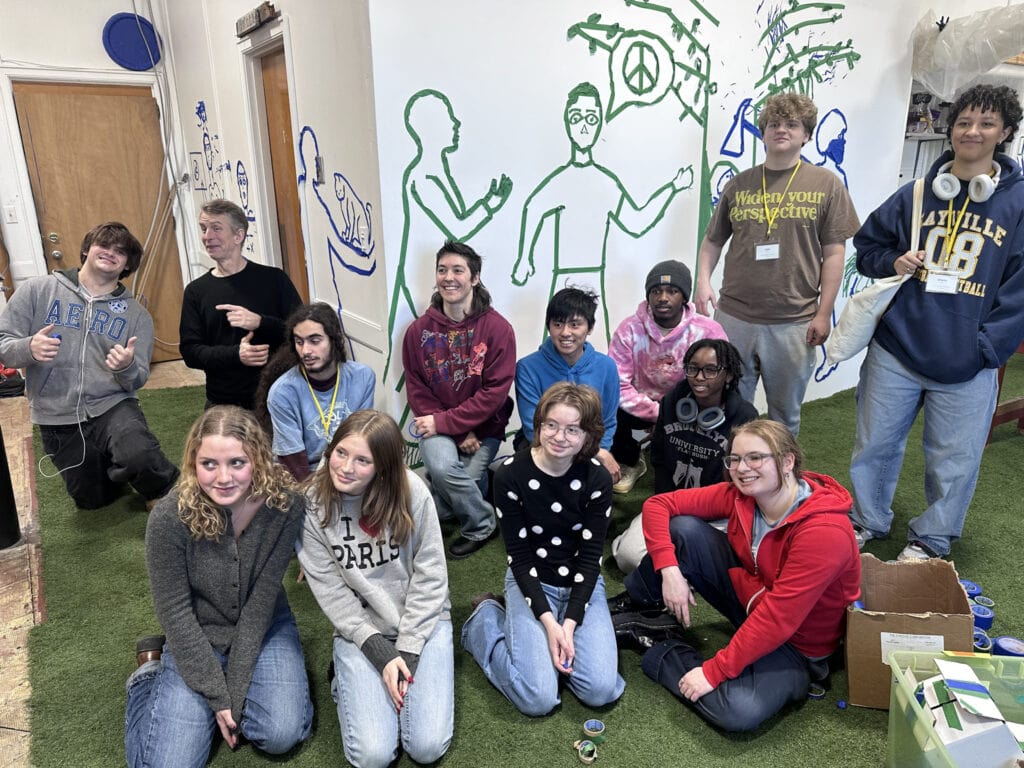
Following the presentation, students collaborated on their own tape art mural, depicting a group of people advocating for peace and environmental care while others attempt to destroy a tree—one cutting it down with an axe and another poisoning it. Students discussed how scale can be symbolic in visual work; they chose to portray the figures attacking the tree as larger, representing the outsized role large corporations play in driving climate change.
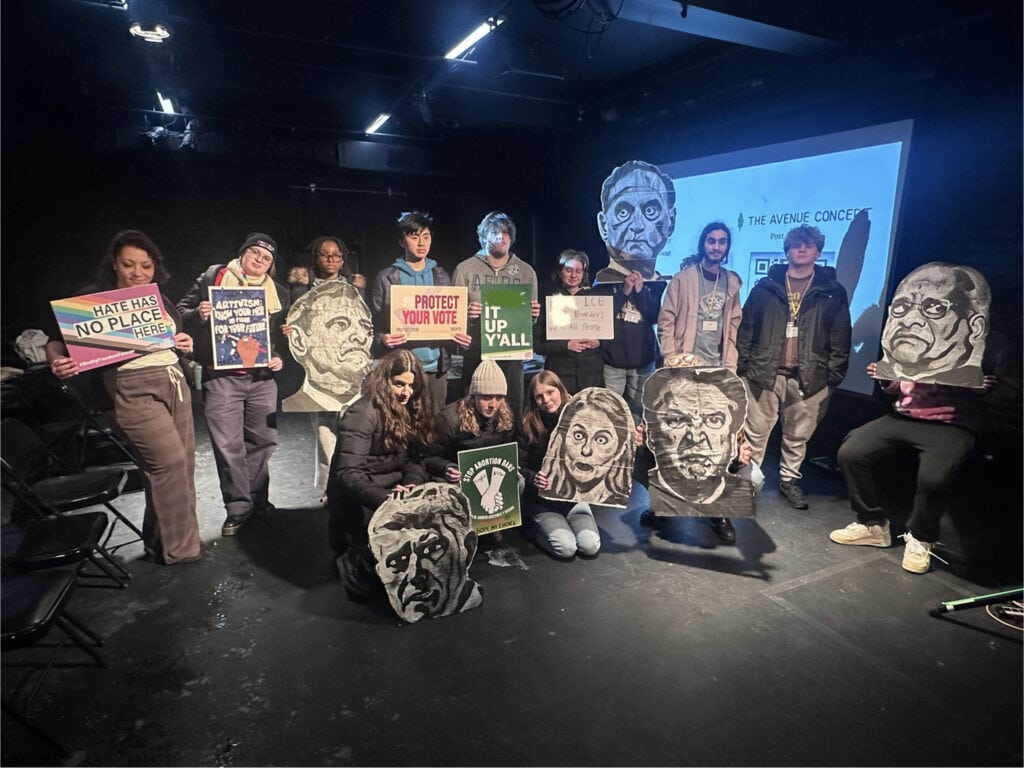
The second excursion brought students to AS220, a nonprofit community arts organization. They heard from The Avenue Concept, which produces public visual art, and The Womxn Project, an organization that uses art to fuel activism and influence legislation in Rhode Island. The presenters shared examples of how public art has been used as a tool for activism, including the mural Still Here, which centers the Narragansett Indigenous people native to Providence.
Other projects addressed issues ranging from reproductive rights to resisting the erasure of women. The Avenue Concept also introduced a graphic illustrating the community engagement spectrum and discussed strategies for involving communities in public art projects. Students then had the opportunity to design protest posters reflecting issues that mattered to them.
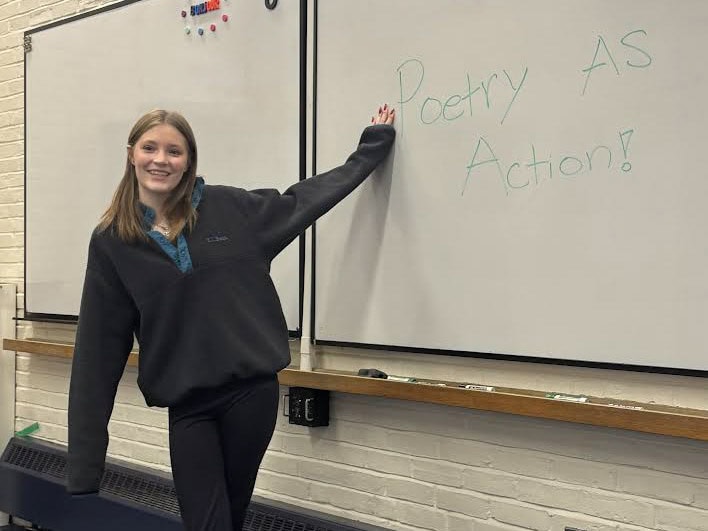
The next day, students attended student-led workshops focused on the intersection of art and activism. MMFS’s own Florence B. led a workshop on poetry, inspired by her MMFS honors project.
At the Quaker Youth Leadership Conference, I led a workshop called Poetry as Action. Here is where I explained the powerful use of poetic expression for activism and protest, rather than the more commonly used art forms of painting or drawing. I wanted to show that you could use your voice in many different ways, even if you’re not artistically inclined. I started by showing two protest poems: “If I Must Die” by Refaat Alareer and “For the Flowers” by me. I wanted to show poems that expressed strong emotion and call for change. After that, I told my peers to think of any social topic or commentary that interested them and to write down their thoughts, anger, guilt, or awareness of the topic they chose. Some chose to write about abortion, anti-war, ICE, and even some conspiracy theories. We held a workshop in which we read everyone’s poems and shared our thoughts on them, showing how protest poetry sparks conversation and awareness within a group. By reading the poems, we were able to delve deeply into global conflicts and express the need for change in these areas. It created an interesting environment and a bright conversation about how we, as writers, can do more to create a better, safer world.
The conference concluded with a Silent Meeting for Worship, during which students shared expressions of gratitude and inspiration. They left eager to carry the lessons and experiences of the conference back to their schools and communities.